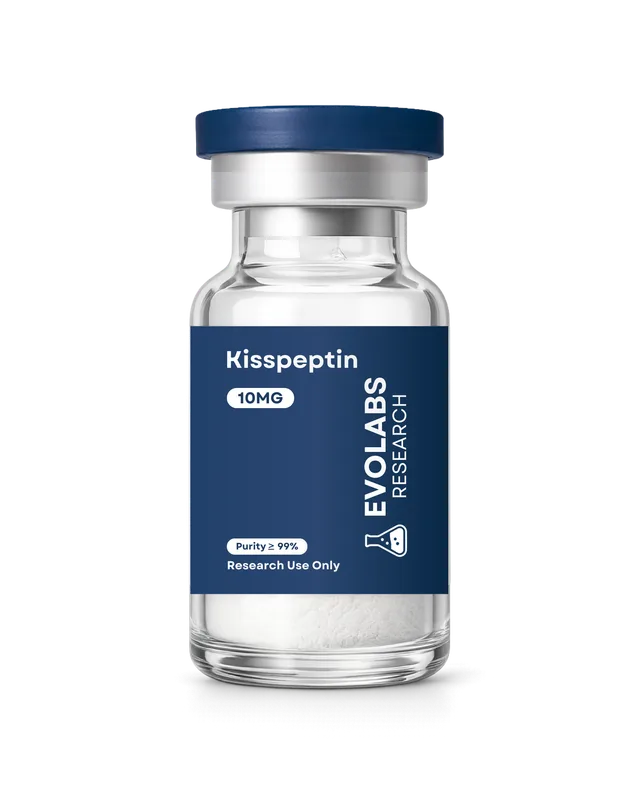
Kisspeptin
A neuropeptide that regulates the hypothalamic-pituitary-gonadal axis. Kisspeptin is studied for its role in hormone regulation, fertility research, and neuroendocrinology.
Compound Profile
Pharmaceutical Data Sheet
Mechanism of Action
How Kisspeptin Works
Kisspeptin-10 is the active decapeptide fragment of the KISS1 gene product, first described in 1996, now recognized as the master upstream regulator of the hypothalamic-pituitary-gonadal (HPG) axis. By binding KISS1R (GPR54) on GnRH neurons, it triggers pulsatile GnRH release, driving LH and FSH secretion to control reproductive hormone cycling, fertility, and puberty onset.
- Gq/11-coupled receptor on GnRH neurons in arcuate nucleus
- Triggers calcium mobilization and neuronal depolarization
- Resets pulsatile GnRH release periodicity
- Rapid and potent LH secretion within minutes of IV dosing
- Increases LH pulse frequency, pulse size, and testosterone secretion
- Sexual dimorphism: variable responsiveness across menstrual cycle phases
- Controls testosterone secretion in males via LH stimulation
- Triggers oocyte maturation in IVF protocols (KP-54)
- KP-10 is less potent in vivo than KP-54 due to shorter half-life
Kisspeptin-10 binds KISS1R on hypothalamic GnRH neurons, activating Gq/11-PLC-IP3 signaling that depolarizes the neuron and triggers pulsatile GnRH release. A 2011 study showed it resets the periodicity of endogenous LH pulse generation, establishing kisspeptin as a key regulator of the central GnRH clock.
George JT et al., J Clin Endocrinol Metab (2011): KP-10 is a potent stimulator of LH and increases pulse frequency in men.
Preclinical Findings
Research Models
Clinical Data
95% Oocyte Maturation in IVF β 62% Live Birth Rate
In IVF studies by Abbara et al., kisspeptin-54 achieved oocyte maturation in 95% of patients, embryo formation in 90%, and live birth rates of 62% at the optimal dose (9.6 nmol/kg). KP-10 administered IV in healthy men produced rapid, potent LH secretion with increased pulse frequency and testosterone elevation (George JT et al., 2011).
Abbara A et al., J Clin Invest (2015); George JT et al., J Clin Endocrinol Metab (2011).
Human RCTs in IVF and reproductive endocrinology
Research Outcomes
Key Research Success Metrics
Safety Profile
Research Safety Notes
- Well tolerated in multiple human clinical trials at IV and SC doses
- No serious adverse events reported in published IVF or reproductive studies
- Short circulating half-life limits clinical utility of KP-10 vs. KP-54
- Sexual dimorphism: women in follicular phase show reduced response vs. preovulatory phase
- Intranasal delivery validated as safe and effective in 2025 double-blind RCT (eBioMedicine)
Kisspeptin is investigational. IVF data pertains primarily to kisspeptin-54; KP-10 is less potent in vivo due to shorter half-life. For research use only.
About Kisspeptin
A neuropeptide that regulates the hypothalamic-pituitary-gonadal axis. Kisspeptin is studied for its role in hormone regulation, fertility research, and neuroendocrinology.
All EVO Labs Research compounds are manufactured to research-grade standards and independently tested by Janoshik Analytical (Prague, est. 2013). The Certificate of Analysis for this compound includes full HPLC chromatography data, mass spectrometry confirmation, net purity percentage, and net content verification.
Research Use Only
This product is strictly for in vitro research and laboratory use only. Not for human or veterinary consumption. By purchasing, you confirm use in a controlled research setting.